

In automated production, equipment rarely fails suddenly.
Rather, signals are sent out before a malfunction occurs.
However, in the past, these signals were difficult to detect.#Festo pneumatic cylinder#Festo pneumatic fittings#Festo valves
With each action, the buffer of the cylinder changes slowly.
The speed gradually deviates and impacts accumulate continuously.
These minor abnormalities often indicate potential risks.
But traditional sensors only tell us one thing:
Has the action reached the position?#Xiamen Shengyuanke Trading Co., Ltd.#FESTO
But they cannot answer another more crucial question:
Is the action still normal?
Therefore, Festo introduced the SOIA inductive distance sensor.
It breaks away from traditional detection methods and, by analyzing real-time data in three dimensions – distance, speed, and acceleration – it enables the operational status of the actuating unit to be perceived, analyzed, and predicted in advance.
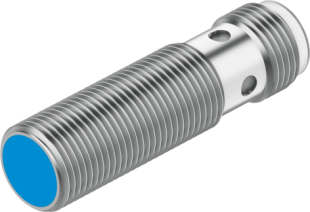
The SOIA does not measure position, but rather the movement itself. Each time the cylinder piston approaches, the SOIA outputs three sets of real-time data: distance, speed, and acceleration. What is being measured, how is it measured, and what are the results?
Distance: Maximum 30mm, displacement resolution 0.01mm, repeatability accuracy ±0.1mm.
Speed: 0.001 … 3.00 m/s.
Acceleration: 0.1 … 3270 m/s².
Data is transmitted in real time via IO-Link 1.1, with the minimum cycle time being only 3.2ms. All calculations are completed within the sensor itself, without the need for additional processing by an external controller.
This means that the data you see is the actual state of the piston at this moment – without delay, without compromise.
Designed specifically for buffering and monitoring purposes
SOIA is particularly suitable for the condition monitoring of elastic, pneumatic and hydraulic buffering components.

The damping element absorbs the impact energy during each movement, ensuring that the cylinder stops smoothly. However, the decline in damping performance never occurs suddenly – the sealing ring is wearing out, the damping gap is changing, and the impact energy is accumulating. These changes occur over hundreds or thousands of movements before complete failure. To capture this gradual change, SOIA provides two measurement windows.
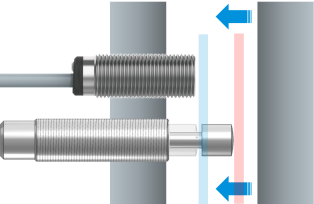
Window 1 monitors the impact speed/energy – telling you “how hard the impact was”
Window 2 monitors the terminal speed/buffer margin – telling you “whether you stopped steadily or not”
Make the changes in the buffer state quantifiable and traceable.
Flexible integration, compatible with existing designs
SOIA offers five specifications: M8, M12, M18, M30 and Q40, and supports both flush and non-flush installations.
In the SIO mode, it can directly replace any PNP/NPN normally open or normally closed contact inductive proximity switch – the hardware interface remains the same, the control logic remains the same, but the output content of the sensor is upgraded from “position signal” to “motion data”.
The upgrade is completed quickly and does not require any changes to the existing design.
From precise monitoring to more efficient equipment design
In addition to enhancing equipment reliability, SOIA can also assist engineers in optimizing equipment design based on real operational data.
By understanding actual speed, impact energy and buffer status, excessive cylinder selection can be avoided: thereby reducing energy consumption and equipment costs, and improving operational efficiency.
These data can also serve as a foundation for subsequent data analysis and intelligent decision-making.
Every movement becomes more reliable
From “Action Completion Detection” to “Operation Status Monitoring”
Festo SOIA distance, speed and acceleration sensors
Help enterprises detect risks in advance
Enable automated equipment to operate more stably and efficiently